Weavetech

What Are the 2026 Top PU Leather Material Types for Buyers?

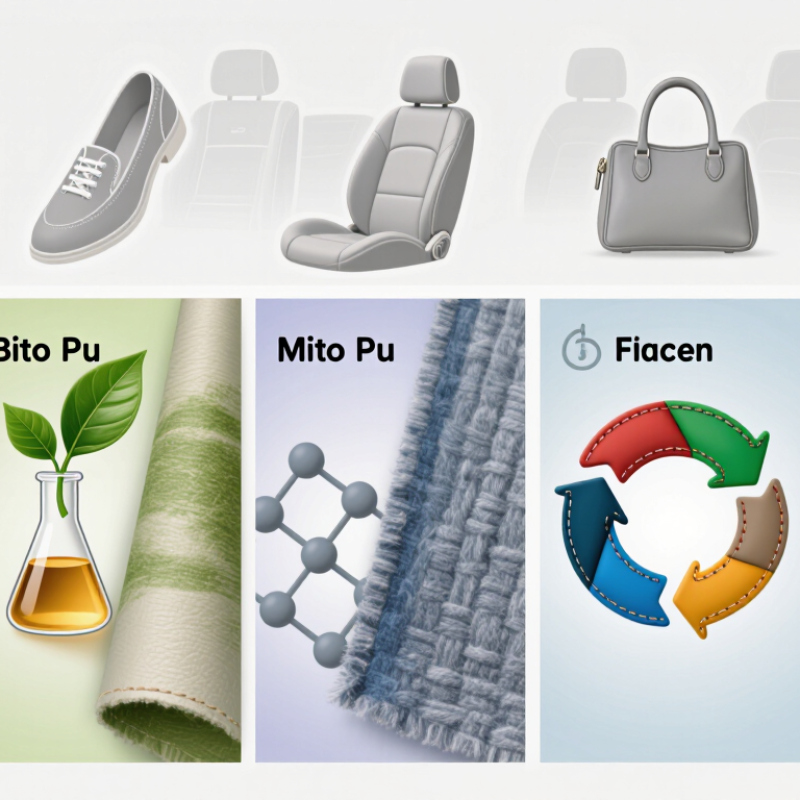
In 2026, buyers will face a wider selection of Pu Leather Material than simple color and grain options. Water-based PU, solvent-free PU, microfiber PU, bio-based PU, and recycled PU are moving into different price and performance tiers. Each type responds to a practical need, such as softer touch, lower odor, improved abrasion resistance, or reduced fossil content.

Market evidence supports this expansion. Fortune Business Insights reports that the global synthetic leather market was valued at approximately USD 38.08 billion in 2023. It projects continued growth through 2032, supported by footwear, automotive interiors, furniture, and fashion applications. Grand View Research also identifies polyurethane-based artificial leather as a major growth segment. However, market reports often group several synthetic materials together. Their figures should not be treated as exact PU-only sales.

Professor Anil K. Bhowmick, a recognized polyurethane researcher, has described polyurethane as “one of the most versatile polymers.” That versatility explains its popularity. It can create a smooth handbag surface, a textured car seat, or a flexible shoe upper. Still, versatility can confuse buyers. Bio-based content does not automatically mean a smaller total footprint. Recycled PU may also require clearer traceability. The best 2026 choice will depend on coating structure, hydrolysis resistance, testing results, and supplier transparency. Not just marketing language. This guide compares the leading Pu Leather Material types and highlights where each one may perform well, where it may fail, and what buyers should verify before placing an order.
What Are the 2026 Top PU Leather Material Types for Buyers?

Classify 2026 PU Leather by Polymer Chemistry, Backing, and Finish

Buyers should classify PU leather by polymer chemistry before comparing colors or price. Polyester-based PU usually offers a firmer hand and sharper embossing. Polyether-based PU often performs better in humid conditions. Hydrolysis resistance still depends on formulation and testing. Do not trust chemistry labels alone.

Grand View Research estimated the global synthetic leather market at about USD 33.7 billion in 2023. Textile Exchange reported that polyester represented roughly 57% of global fiber production in 2023. These figures explain why polyester backings remain common. Woven polyester gives dimensional stability, while microfiber and nonwoven backings create softer drape. Cotton-backed PU can feel natural, but moisture control requires closer inspection. Check peel strength, thickness tolerance, and seam behavior.

Finish changes both appearance and service life. Embossed grain hides minor surface variation and supports consistent visual matching. Matte finishes reduce glare, while glossy films create a sharper, coated look. Buyers should request abrasion, flexing, and hydrolysis data under relevant test methods. Waterborne PU may help reduce solvent emissions, but “water-based” does not automatically mean durable. That assumption is risky. In my sourcing experience, a soft sample can fail after repeated flexing. A better specification records polymer type, backing weight, finish thickness, test conditions, and acceptable defects. No classification is perfect. Suppliers should disclose the compromises.

Water-Based PU: Compare VOC Results in g/L with REACH and SDS Data

For 2026 PU leather purchasing, water-based PU deserves closer VOC scrutiny. “Water-based” does not mean VOC-free. Co-solvents, residual monomers, and additives may still evaporate during drying or use.

Compare results in g/L only when the test method matches. U.S. EPA Method 24 measures volatile material after controlled heating, while ISO 11890-2 uses gas chromatography for many coating systems. A supplier reporting 18 g/L by ISO 11890-2 cannot be compared directly with 65 g/L from another method. Check the method, sample condition, moisture correction, and laboratory date. The European Commission’s JRC BREF on surface treatment also stresses solvent control at process level, not just product claims. That distinction matters.

REACH is different. ECHA’s REACH guidance uses substance thresholds, such as 0.1% weight by weight for certain SVHC communication duties. It does not create one universal VOC limit for PU leather. SDS Section 3 should identify relevant hazardous ingredients, while Section 9 may list VOC content, density, or flash point. Ask for the full SDS and an independent test report. Do not accept “low VOC” alone.

A practical screening target can be below 50 g/L, but it is not a legal guarantee. Some water-based PU samples perform well. Others disappoint after heat aging. I would request fresh and aged results, because production moisture and drying temperature can change the measured number. The weak point remains consistency. A clean-looking certificate may hide an incomplete test scope.

2026 Top Water-Based PU Leather Material Types: VOC Comparison

Representative VOC screening values in g/L for common water-based polyurethane leather systems. Actual values vary by formulation and must be verified in the current supplier SDS.

Lower VOC values generally indicate lower volatile solvent content. REACH does not establish one universal VOC limit in g/L for all PU leather materials; buyers should compare the supplier’s SDS, especially Sections 3, 9 and 15, together with the applicable EU or national VOC requirements. The 50 g/L line is a buyer screening reference only, not a REACH legal limit.

Microfiber PU: Target 20,000–100,000 Martindale Cycles Under ISO 12947

What Are the 2026 Top PU Leather Material Types for Buyers?

Microfiber PU is gaining attention for demanding upholstery applications. Its dense fiber structure supports better abrasion resistance than many standard PU constructions. Under ISO 12947, buyers should target 20,000–100,000 Martindale cycles for commercial seating. Residential furniture may need less, but frequent-use areas deserve higher protection.

A 2024 Grand View Research report estimated the global synthetic leather market at about USD 63.3 billion in 2023. It also projected a 7.5% compound annual growth rate through 2030. These figures show strong demand, but market growth does not guarantee equal material quality. Testing still matters.

ISO 12947 results can vary with pressure, fabric backing, finishing, and laboratory conditions. A high cycle number may not predict excellent hydrolysis resistance or color stability. That is easy to overlook.

Tips:

Request the full test method, load, abrasive fabric, and failure definition. Ask for hydrolysis data when products face humidity or heat. Check a physical sample under bending and rubbing. Do not judge softness alone.

In my experience, overly smooth microfiber PU can reveal surface wear sooner than expected. A balanced structure often performs better, even when it feels slightly less luxurious. Suppliers should also disclose thickness, backing composition, and production batch consistency.

Bio-Based PU: Report Biogenic Carbon Percentages Using ASTM D6866

In 2026, buyers are comparing bio-based PU with water-based and solvent-free PU systems. Bio-based PU replaces part of its fossil feedstock with renewable sources, such as plant-derived oils. The critical question is not simply whether a product is called bio-based. Buyers need measurable evidence.

ASTM D6866 reports the percentage of biogenic carbon in a tested sample. It uses radiocarbon analysis to distinguish recent biological carbon from fossil carbon. That distinction matters. A PU material may contain renewable carbon, fossil-based polymers, pigments, and textile backing. Therefore, a 30% biogenic carbon result does not mean the entire product is 30% plant-based. It describes the tested carbon portion under the stated method.

Ask suppliers for a current ASTM D6866 report, sample identification, test date, and laboratory details. The document should clarify whether testing covered resin, coating, finished leather, or a composite structure. Sample preparation can influence interpretation. Testing the finished material is usually more useful than testing only the liquid formulation. Sampling details matter.

Buyers should also compare abrasion resistance, hydrolysis performance, flexibility, odor, and coating adhesion. A high biogenic percentage cannot compensate for early cracking on a heavily used seat or bag. Batch variation is another concern. Requesting multiple production samples may reveal differences hidden by one report. Some declarations remain too vague, and that is worth challenging. A supplier’s percentage should be treated as evidence, not a marketing shortcut.

What Are the 2026 Top PU Leather Material Types for Buyers? — Bio-Based PU: Report Biogenic Carbon Percentages Using ASTM D6866

PU Leather Material Type Typical Chemistry or Structure Potential Bio-Based Feedstock Expected ASTM D6866 Biogenic Carbon Result Relative Bio-Based Position Key Buyer Advantages Important Buyer Checks
Conventional Solvent-Free PU Leather Polyurethane coating applied without intentionally added biogenic carbon; commonly supported by textile or microfiber backings. None intentionally included in the polymer formulation. Approximately 0% biogenic carbon when the coating and backing are entirely fossil-derived. Baseline Consistent appearance, established processing, broad color and embossing options, and no solvent-recovery requirement during coating. Confirm total product composition, backing material, hydrolysis resistance, abrasion performance, and whether the reported result covers the complete article or only the PU layer.
Waterborne PU Leather PU dispersion in water used to form the surface coating; water is the primary carrier during application. May be fossil-based or combined with bio-based polyols. 0% if fossil-based; the result is formulation-dependent when bio-based polyols are added. Variable Lower volatile organic compound potential than many solvent-based systems, good surface uniformity, and suitability for soft-touch finishes. Request VOC data, residual solvent information, coating solids, wet and dry rub performance, and an ASTM D6866 report for the exact finished material.
Castor-Oil-Polyol Bio-Based PU Leather PU made partly with polyols derived from castor oil; the isocyanate component may still be fossil-derived. Castor seeds and castor oil derivatives. Often measurable but formulation-specific; commonly a low-to-moderate percentage of total organic carbon rather than 100%. Moderate Can reduce dependence on fossil-derived polyol feedstocks while maintaining flexible PU properties. Do not convert bio-based polyol percentage directly into biogenic carbon percentage. Require ASTM D6866 testing, renewable-content allocation, tensile strength, flex resistance, and hydrolysis data.
Bio-Polyol PU Leather from Sugar or Starch Feedstocks PU formulation using polyols or intermediates made from carbohydrate-based raw materials. Sugarcane, corn, starch, or other plant-derived carbohydrate sources. Variable and generally partial; the final percentage depends on the amount of bio-based carbon retained in the finished coating and backing. Moderate Provides a scalable route to partially renewable PU chemistry and can be formulated for a wide range of softness and hand-feel requirements. Check feedstock traceability, land-use claims, mass-balance accounting, ASTM D6866 scope, coating adhesion, colorfastness, and resistance to hydrolysis.
Bio-Based Polyester-PU Leather Polyurethane system incorporating a polyester polyol with selected renewable-content intermediates. Bio-based succinic acid, plant-derived diols, or other renewable chemical intermediates. Usually partial and formulation-dependent; no universal percentage applies to all bio-based polyester-PU products. Moderate Can provide a balanced combination of abrasion resistance, flexibility, and a renewable-content pathway. Request polymer composition, ASTM D6866 percentage, accelerated aging results, flex-crack resistance, peel strength, and performance after exposure to moisture and heat.
Bio-Based Polycarbonate-PU Leather PU chemistry incorporating polycarbonate-based polyols, some of which may contain renewable carbon. Plant-derived carbonates or other renewable feedstocks, depending on the polyol route. Potentially partial; the measured value must be determined on the exact formulation because the isocyanate and other components may remain fossil-derived. Moderate Often selected for demanding durability requirements, including improved resistance to hydrolysis compared with some conventional polyester-PU systems. Verify ASTM D6866 results, hydrolysis testing, flex durability, surface coating adhesion, and the percentage of renewable carbon in the complete article.
PU Leather with Bio-Based Surface Coating and Synthetic Backing Renewable-content PU coating laminated or coated onto a polyester, nylon, microfiber, or other synthetic textile backing. Plant-derived polyols or renewable intermediates in the topcoat only. May be lower for the complete product than for the coating alone because the backing can contribute substantial fossil-derived carbon. Moderate Allows targeted renewable-content improvement while retaining familiar backing strength and manufacturing equipment. Ensure the ASTM D6866 sample represents the full finished construction. Ask for coating-only and whole-product results when both claims are made.
Recycled-Content PU Leather PU material containing mechanically or chemically recycled polymer or recycled textile components. Post-industrial or post-consumer PU and textile waste; feedstock is not necessarily biogenic. Not determined by recycled-content claims. ASTM D6866 measures modern biogenic carbon, so recycled fossil-based PU can still show approximately 0% biogenic carbon. Separate Attribute Can reduce demand for virgin material and support waste-diversion objectives without requiring bio-based chemistry. Use a separate recycled-content standard or chain-of-custody document. Do not use ASTM D6866 alone to verify recycled content or circularity.
PU Leather with Cellulosic or Plant-Fiber Backing PU surface layer combined with a cellulose-rich or plant-fiber textile backing. Cotton, hemp, flax, wood pulp, or other cellulosic fibers in the backing. Can produce a higher whole-product biogenic-carbon result than a PU coating alone, but the percentage varies with fiber content, finish, and backing construction. Potentially High Combines a familiar PU protective surface with renewable carbon in the textile structure and may offer a distinctive natural hand-feel. Check fiber composition, moisture behavior, dimensional stability, delamination, abrasion, mildew management, and ASTM D6866 testing on the complete finished material.
Bio-Based PU Leather with a Recycled or Bio-Based Backing Multi-layer construction combining a partially bio-based PU coating with recycled or plant-derived textile support. Bio-based polyols, cellulosic fibers, recycled polyester, or combinations of these inputs. Potentially higher than a bio-based coating alone, but the actual value is construction-specific and must be measured on the finished article. Potentially High Can address renewable-content and recycled-content targets in one product while preserving design flexibility. Obtain separate evidence for biogenic carbon, recycled content, and fiber composition. Review chemical restrictions, bonding agents, end-of-life compatibility, and durability test results.
Buyer note: ASTM D6866 reports the proportion of modern biogenic carbon in the tested organic carbon fraction; it does not directly report bio-based mass percentage, renewable-energy use, recycled content, biodegradability, or compostability. For accurate procurement claims, request a current ASTM D6866 test report for the exact finished PU leather construction, including its coating, adhesive, and backing where applicable.

Recycled PU: Verify Recycled Content Through GRS Chain-of-Custody Records

Recycled PU is becoming a practical choice for 2026 buyers seeking lower-impact leather alternatives. It uses recovered plastic-based materials in the coating or backing structure. However, “recycled” should never be accepted as a loose sales phrase. Buyers need traceable evidence.

The Global Recycled Standard (GRS) chain of custody records can connect recycled input materials with production stages. Ask suppliers for valid scope certificates and transaction records covering the specific shipment. Check the material description, recycled percentage, facility name, certificate dates, and product quantities. These details can reveal gaps between a general factory certificate and your actual order. A certificate alone may not prove every roll contains the same recycled content. That is an easy mistake.

Tips: Request documents before sampling. Match certificate data with invoices, batch numbers, and packing lists. Ask how recycled fibers, films, or PU components are separated from conventional materials. Keep your own records for future audits. If the supplier gives unclear answers, pause the purchase.

Recycled PU can still vary in softness, abrasion resistance, color stability, and odor. Test samples under real conditions, such as folding, stitching, moisture exposure, and repeated rubbing. I have found that sustainability claims sometimes receive more attention than performance testing. That balance needs improvement. Buyers should also confirm whether the recycled content applies to the full material or only one layer. Small wording differences can change the commercial meaning.