
2026 Top Textured Yarn Types for Global Buyers
Global buyers are rethinking textured yarn as performance, appearance, and supply reliability converge. The right selection can influence stretch, recovery, softness, bulk, and fabric stability. It can also affect dye uptake, machine efficiency, and final garment comfort.
Textile engineering specialist Dr. Subhash Anand offers a practical principle: “Yarn performance is judged in fabric, not on the cone.” This view matters when comparing air-textured, false-twist, friction-spun, slub, boucle, chenille, and elastane-blended constructions. Each type creates a different surface story. Some produce quiet softness. Others deliver visible loops, crisp irregularity, or a hand-feel similar to brushed wool.
This guide examines the leading textured yarn types expected to attract global buyers in 2026. It considers fiber content, production behavior, end-use suitability, and purchasing risks. A fine polyester textured yarn may support activewear and lining applications. A recycled polyamide option may suit buyers seeking lower-impact collections. A cotton-rich slub yarn can add character to casual fabrics, though its irregularity may complicate quality control.
There is no universal winner.
That is worth remembering.
Cost often dominates early discussions, but it should not stand alone. Buyers also need clear specifications, sample testing, colorfastness data, and dependable lot consistency. Some comparisons remain imperfect because supplier terminology varies across regions. Even experienced teams can overlook twist, heat-setting, or moisture behavior.
The following overview offers a practical starting point. It does not replace laboratory testing or production trials. It helps buyers ask sharper questions before committing to volume.
What Textured Yarn Is and How It Differs from Smooth Yarn
2026 Top Textured Yarn Types for Global Buyers
What Textured Yarn Is and How It Differs from Smooth Yarn
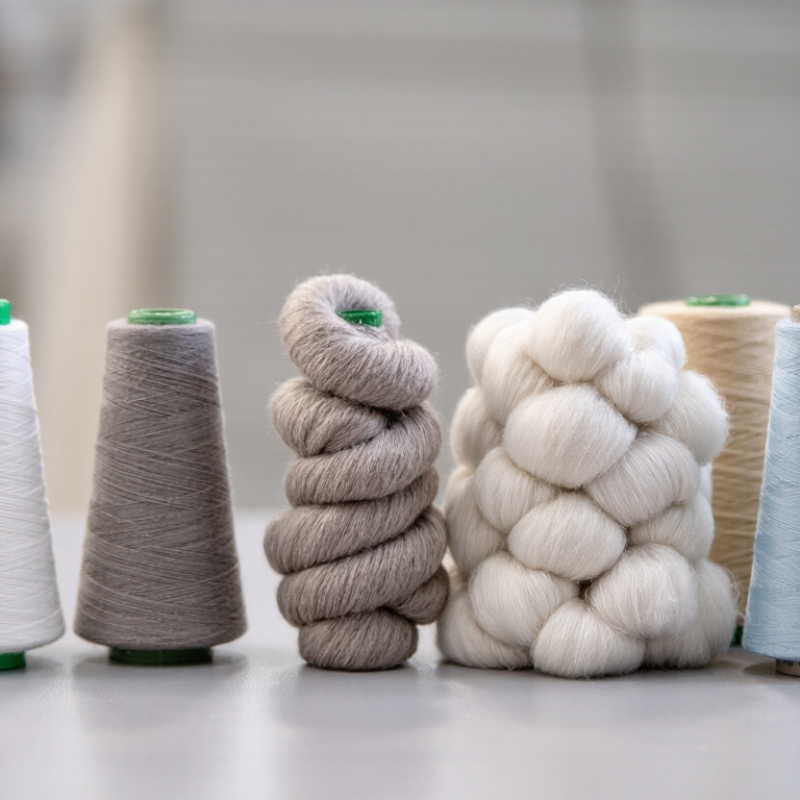
Textured yarn is a filament yarn modified to create bulk, stretch, softness, or surface movement. Manufacturers use methods such as false-twist, air-jet, and crimping. These processes change the filament shape without changing its basic polymer structure.
Smooth yarn usually has straighter, more parallel filaments. Its surface looks clean and even under light. Textured yarn appears fuller and may show loops, waves, or gentle irregularities. It can feel springy rather than slippery. Not every textured yarn feels rough. Fiber content and finishing still matter.
The difference becomes clear during fabric testing. Smooth yarn often produces a flatter surface and sharper color reflection. Textured yarn can hide minor fabric creases and create a softer visual depth. It may also improve stretch recovery in sportswear, socks, upholstery, and fitted garments. However, texture can increase heat-setting sensitivity and dyeing variation.
Check the technical sheet carefully. Important values include denier or dtex, filament count, crimp level, elongation, shrinkage, and torque. In practical sampling, a buyer should inspect the yarn before and after washing. A cone can look stable but reveal uneven bulk later. That is an easy detail to miss.
A small caution: higher bulk does not always mean better performance. Excessive texture may cause snagging, knitting tension problems, or unwanted shade changes. Trial orders should match the final machine settings. Tiny differences matter.
2026 Top Textured Yarn Types for Global Buyers - What Textured Yarn Is and How It Differs from Smooth Yarn
A practical comparison of common textured yarn constructions, typical specifications, performance characteristics, and purchasing considerations. Values are representative commercial ranges and may vary by polymer, fiber, processing method, and end use.
| Yarn Type | How It Is Made | Common Fiber or Polymer | Typical Linear Density | Typical Stretch or Bulk Behavior | Surface Appearance | Main Advantages | Common End Uses | Key Buying Considerations |
|---|---|---|---|---|---|---|---|---|
| Draw Textured Yarn (DTY) | Partially oriented filament yarn is drawn and simultaneously false-twist textured to create crimp and controlled bulk. | Polyester, nylon, and occasionally polypropylene | Approximately 30–600 dtex | Moderate bulk; elongation commonly about 15–35%, depending on process and grade | Soft, slightly crimped, matte to semi-bright | Good cover, softness, dimensional comfort, and efficient high-speed knitting performance | Knitted apparel, sportswear, hosiery, underwear, home textiles, and lightweight fabrics | Check intermingling, twist level, shrinkage, luster, dye uniformity, and lot-to-lot consistency |
| Air-Textured Yarn (ATY) | Continuous filaments are passed through an air jet that entangles and loops the filaments, producing a spun-yarn-like effect. | Polyester, nylon, and polypropylene | Approximately 70–1,200 dtex | High bulk and cover; stretch is usually limited unless elastomeric filaments are included | Fuzzy, lofty, irregular, and similar to spun yarn | Strong visual texture, good cover, abrasion resistance, and reduced filament shine | Performance apparel, upholstery, automotive textiles, outdoor fabrics, and technical textiles | Evaluate bulk retention, filament cohesion, hairiness, snag resistance, and fabric abrasion performance |
| Interlaced Textured Yarn | Filaments are pneumatically interlaced at regular intervals to improve cohesion; additional texturing may also be applied. | Polyester and nylon | Approximately 30–300 dtex | Low to moderate bulk; limited inherent stretch | Generally smooth with small, visible or low-profile entanglement points | Improved filament integrity, easier weaving, lower risk of filament separation, and stable processing | Warp knitting, weaving, narrow fabrics, sewing threads, and industrial fabrics | Specify interlace-node count, cohesion, tensile strength, and compatibility with loom or knitting equipment |
| Integrated Textured Yarn (ITY) | Two or more filament components with different shrinkage or stretch behavior are combined and textured to create a soft, natural-looking effect. | Polyester, nylon, and blended filament systems | Approximately 50–500 dtex | Moderate bulk, enhanced recovery, and controlled differential shrinkage | Soft, rich, and often similar to a spun or natural-fiber surface | Natural appearance, improved drape, softness, and reduced fabric uniformity defects | Fashion apparel, dresses, blouses, sportswear, scarves, and home furnishings | Confirm component ratio, boiling-water shrinkage, dye compatibility, torque, and fabric dimensional stability |
| Covered Yarn | An elastic or core filament is wrapped once or twice with another filament or spun yarn to conceal the core. | Elastane core with nylon or polyester covering; also non-elastic core constructions | Approximately 20–600 dtex | High stretch when elastane is used; stretch commonly ranges from about 80–400% by construction | Smooth, compact, or lightly textured outer surface | Controlled stretch, excellent recovery, core protection, and improved comfort | Hosiery, swimwear, activewear, underwear, medical textiles, and fitted garments | Check covering uniformity, bare spots, elongation, recovery, chlorine or heat resistance, and winding tension |
| Slub Yarn | Thicker sections are deliberately introduced at irregular or programmed intervals along the yarn length. | Cotton, linen, viscose, polyester, acrylic, and blended fibers | Highly variable; commonly specified by base count and slub size or frequency | Usually low stretch; texture is created by mass variation rather than filament crimp | Clearly visible thick-and-thin effect with an artisanal appearance | Distinctive visual character, low-repeat design options, and strong surface interest | Denim, casualwear, shirting, sweaters, decorative fabrics, and home textiles | Define slub length, thickness ratio, frequency, repeat pattern, strength loss, and weaving or knitting suitability |
| Bouclé Yarn | A loop-forming effect yarn is created by feeding one or more components at different rates around a core or binder yarn. | Wool, acrylic, cotton, viscose, polyester, and blended fibers | Approximately 100–2,000 tex, depending on construction | High visual bulk; mechanical stretch is generally low unless an elastic component is added | Looped, nubby, and highly dimensional | Rich texture, warmth, visual depth, and strong decorative appeal | Coats, knitwear, upholstery, blankets, scarves, and decorative accessories | Assess loop anchoring, snag resistance, pilling, shedding, yarn evenness, and machine compatibility |
| Chenille Yarn | Short pile fibers are arranged around a central core, producing a velvet-like yarn surface. | Cotton, viscose, acrylic, polyester, and blended fibers | Approximately 100–2,000 tex | Very high softness and bulk; stretch is normally low | Velvety, plush, and highly opaque | Excellent softness, warmth, cover, and three-dimensional surface effect | Home textiles, blankets, upholstery, rugs, scarves, and decorative knitwear | Check pile anchoring, shedding, abrasion resistance, compression recovery, and wet-cleaning behavior |
| Stretch-Textured Yarn | Elastic or high-shrinkage components are combined with crimped filaments to provide both stretch and surface texture. | Nylon, polyester, elastane, and bicomponent filament systems | Approximately 30–500 dtex | Moderate to high stretch; recovery depends on elastane content and heat-setting conditions | Crimped, springy, and close-fitting in fabric constructions | Comfortable movement, body fit, recovery, and enhanced fabric resilience | Sportswear, swimwear, hosiery, leggings, underwear, and fitted garments | Review power, elongation, recovery after repeated extension, heat resistance, and chemical resistance |
| Smooth Filament Yarn — Reference | Continuous filaments are spun and wound with little or no added crimp, looping, or intentional mass variation. | Polyester, nylon, polypropylene, viscose filament, and other continuous-filament materials | Approximately 20–1,000 dtex | Usually low bulk and low inherent stretch, except for specially engineered polymers or constructions | Uniform, sleek, lustrous or semi-dull, and relatively flat | Clean appearance, low hairiness, consistent processing, and efficient low-friction performance | Linings, woven fabrics, sewing threads, ribbons, technical fabrics, and sleek sportswear | Choose when uniformity, smooth hand, low bulk, and a clean surface are more important than texture or loft |
Note: dtex expresses grams per 10,000 meters of yarn, while tex expresses grams per 1,000 meters. Stretch, shrinkage, bulk, and performance values are typical industry ranges rather than universal specifications.
Related Posts
-
How to Choose the Right Textured Yarn for Your Knitting Projects?
-
10 Essential Tips for Choosing the Perfect Weave Fabric?
-
What Is the Best Yarn for a Weaving Loom?
-
2026 Top Loom Machine Trends You Need to Know About
-

Top Polyester Yarn Types and Their Uses in Modern Textile Industry?
-
How to Choose the Best Bobbin Winder Machine for Your Sewing Needs