China Best Pipe Swaging Machine Manufacturers for Global Buyers
China has a broad manufacturing base, but choosing a supplier requires more than comparing prices. A Pipe Swaging Machine must form the specified tube or rod consistently, without visible cracking or unacceptable dimensional variation. Buyers should examine material range, maximum workpiece size, forming force, tooling options, cycle time, and inspection records. Details matter. A polished catalogue cannot replace a sample run using the buyer’s actual material.
Market conditions add context. The World Steel Association’s October 2024 Short Range Outlook estimated global steel demand at 1,751 million tonnes for 2024, a 0.9% decline, and forecast a 1.2% rebound in 2025. This report tracks steel demand, not swaging-machine sales, so it should not be treated as a direct measure of equipment demand. Still, it illustrates why manufacturers and buyers watch shifts in steel processing and investment. Public market reports rarely isolate pipe-swaging equipment, making supplier-level evidence especially useful.
This guide introduces China-based manufacturers for global buyers and outlines practical ways to assess their capabilities. Compare machine specifications, control systems, tooling support, spare-part availability, and documented quality checks. Ask for clear answers about commissioning and technical service across time zones. Request videos or test results, then verify that they match the offered configuration. Small differences can matter. A machine may look suitable on paper, yet require different tooling for a particular wall thickness or alloy. Supplier claims deserve careful review, including this guide’s own comparisons; product ranges and service arrangements can change.
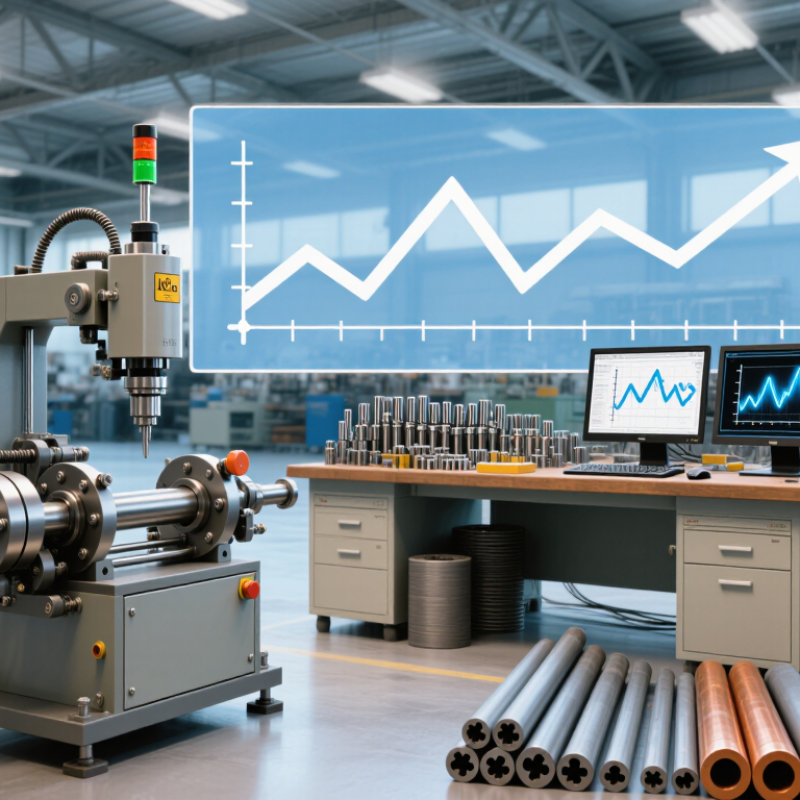
What Pipe Swaging Machines Do and How They Work
Pipe swaging machines reshape a pipe’s end so it can fit into another component, accept a joint, or form a controlled taper. Unlike cutting, swaging changes the metal’s shape without removing material. The pipe is held in a fixture while matched dies press or strike its end inward. A clean result depends on the pipe alloy, wall thickness, starting diameter, and die profile. Small details matter.
Machine designs vary. Some use a hydraulic press to close dies in a single controlled stroke; rotary types use repeated impacts around the workpiece. The operator aligns the pipe with the tooling and selects suitable pressure or cycle settings. A short stainless-steel tube may need gradual reduction to avoid folds, while softer copper can deform more readily. Check the finished end for roundness, cracks, and fit—not appearance alone.
Repeatable results rely on sound tooling, secure clamping, and regular measurement with gauges or calipers. A trial piece can reveal springback or uneven die marks before a full run. Even experienced operators may need to adjust settings when material batches vary; that factor is easy to underestimate. Machines improve consistency, but the process still needs careful inspection.
How to Evaluate Pipe Swaging Machine Manufacturers in China
When evaluating pipe swaging machine manufacturers in China, look beyond catalog photos and headline capacity. Ask whether a machine can process your tube material, diameter range, wall thickness, and target reduction. Request a trial with sample tubes matching your production needs. Watch the full cycle, including loading, clamping, swaging, and unloading. Small details matter. Measure finished diameters at several points and check for visible marks, cracking, or uneven transitions.
Ask for sample inspection records, machine specifications, and a clear description of how repeatability is checked. Confirm which tooling comes with the machine and how long a changeover typically takes. A polished video is not proof of stable production. If possible, observe repeated cycles and compare several finished parts. Results can vary with material and setup, so one successful sample should not settle the question.
After-sales support deserves the same scrutiny as machine performance. Ask who responds to technical questions, what spare parts are commonly stocked, and whether manuals and operating instructions are available in a language your team can use. Request contact details for previous buyers with similar applications, then ask about downtime and service response. No supplier is perfect, and a missed detail in your own requirements can cause trouble too. State your acceptance criteria in writing before placing an order.
Notable Chinese Manufacturers and Their Product Strengths
Chinese pipe swaging machine manufacturers serve global buyers with hydraulic and servo-driven systems for tube ends, fittings, and formed connections. Their strengths often include configurable die sets, PLC controls, and options for automatic feeding. On a factory visit or video acceptance test, check whether dies close evenly and whether sample tubes show ovality or wall thinning. Small details matter. The International Federation of Robotics reported 276,288 industrial robot installations in China in 2023, or 51% of global installations. That manufacturing base can support automation, but it does not guarantee every swaging line has reliable integration.
Product capabilities vary by machine. Some suppliers focus on compact units for short production runs; others build multi-station lines for repeat processing. Ask for trial results using your actual tube material, diameter, and wall thickness. Measure finished-end dimensions and inspect the transition under magnification. The World Steel Association’s October 2024 outlook projected global steel demand of 1,751 million tonnes in 2024 and 1,772 million tonnes in 2025, indicating a substantial industrial materials market, not a direct forecast for swaging equipment. Compare cycle time, tooling-change time, spare-part lead times, and operator training. A polished brochure is not enough. One weak point can be after-sales troubleshooting across time zones. Request a documented acceptance checklist, then verify the tolerances yourself.
Key Machine Specifications for Different Production Needs
Choosing a pipe swaging machine starts with the tube, not the headline tonnage. Record the material, outside diameter, wall thickness, and target end profile. A 25 mm stainless tube with a thick wall needs different forming force from a thin copper tube. Check the working range against your smallest and largest parts. Leave capacity for real production variation. Too much unused capacity can raise cost without improving the finished joint.
Compare rated force, stroke, spindle or die arrangement, and tooling-change time. Ask for repeatability data on your actual material and dimensions, not only a maximum capacity figure. Cycle time matters, but so does setup time between batches. Check control functions, guarding, and maintenance access. A clear die-change area saves minutes. Those minutes add up. Catalog numbers can flatter a machine; sample trials reveal springback, surface marks, and dimensional drift. I would still test parts from more than one material lot.
Automation may also shape specification choices. The International Federation of Robotics’ World Robotics 2024 report counted 4.28 million industrial robots operating worldwide in 2023, a 10 percent annual increase. That figure is not specific to swaging, but it signals broader demand for connected production. For automated lines, confirm signal interfaces, cycle consistency, and safe loading arrangements. For smaller workshops, a simpler control system may be easier to support. The best specification is the one your operators can maintain, and this is easy to underestimate.
Export, Compliance, and After-Sales Support for Global Buyers
For global buyers, a pipe swaging machine is only as dependable as its export plan. UNCTAD’s Review of Maritime Transport 2024 reports that over 80% of world trade by volume moves by sea. That makes crate strength, moisture protection, and clear handling labels practical priorities, not minor details. Buyers should request shipping dimensions, gross weight, loading photos, and a packing list before dispatch. Small gaps matter.
Compliance needs destination-specific checks. Confirm the machine’s electrical requirements, safety documentation, and required conformity assessments before payment; requirements differ by market and machine configuration. The World Bank’s Logistics Performance Index 2023 evaluates 139 economies across customs, infrastructure, logistics services, tracking, and timeliness. Its framework is a useful reminder: a compliant product can still face delays when shipment documents or delivery coordination are weak. Ask the manufacturer to identify who prepares each document and who resolves customs queries. A polished manual cannot fix missing paperwork.
After-sales support should be agreed in writing. Specify warranty coverage, response times, remote troubleshooting, operator training, and availability of wear parts such as dies and seals. Request a parts list with item codes and lead times, plus video guidance for routine setup. A response promise is not the same as a repair. Still, buyers should test the support process before a breakdown, perhaps by asking a technical question and checking how clearly the supplier answers. Export readiness is demonstrated in the details.
