China Top Cross Lapped Spunlace Nonwoven Manufacturers
China has become an important sourcing destination for spunlace nonwovens, including cross-lapped materials used in wipes, hygiene products, and selected industrial applications. A Cross-Lapped Spunlace Nonwoven is formed by layering fibers in alternating directions before water-jet bonding. This structure can support balanced strength and softness, though results depend on fiber blend, basis weight, and production controls.
The right manufacturer offers more than a competitive quotation. Buyers should examine technical data, sample consistency, production capacity, and quality records. Ask how the supplier monitors web formation and hydroentanglement, and whether test results match the intended end use. Small differences matter. A fabric that feels uniform on a sample roll may behave differently during high-speed converting.
This guide introduces China-based manufacturers and the points worth checking before a purchasing decision. It considers product range, customization, communication, and evidence of quality management. Company descriptions and specifications can change, so confirm current details directly with each supplier. Do not rely on a polished catalog alone. Request representative samples and clear documentation.
There is no single best producer for every project. A suitable partner for disposable wipes may not fit an application requiring a different tensile profile or fiber composition. Buyers should also discuss lead times, packaging, and shipment conditions early. Those details are easy to overlook. The comparison that follows is intended as a starting point, not an endorsement; careful verification remains essential.
What Is Cross-Lapped Spunlace Nonwoven?
Cross-lapped spunlace nonwoven is a fabric made by layering loose fiber webs in alternating directions, then binding them with fine, high-pressure water jets. The crosswise layers help distribute fibers across the sheet, rather than leaving most of them aligned in one direction. Water does the bonding. No weaving or knitting is involved.
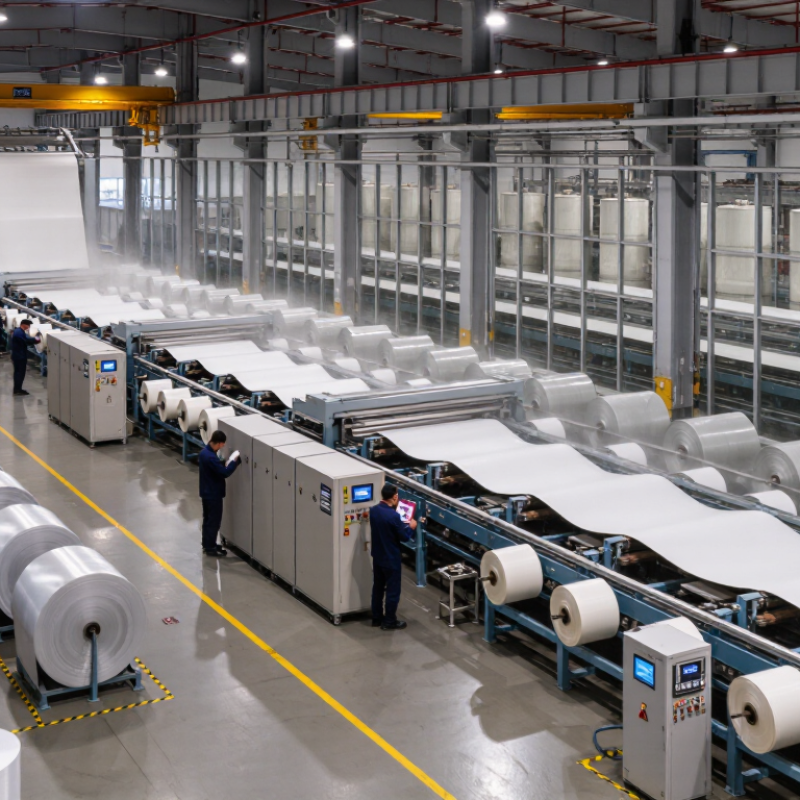
Manufacturing begins with prepared fibers, often viscose, polyester, or a blend, formed into a thin web. A cross-lapper places successive webs at angles, building the desired weight and structure. The layered material then passes beneath rows of water jets, which entangle the fibers. It is dried and wound into rolls. The exact result depends on fiber type, web weight, jet pressure, and finishing. Small process changes matter.
The cross-laid structure can provide balanced strength in both machine and cross directions, along with softness and good drape. These features suit products such as wipes, cosmetic pads, and certain medical or hygiene materials, depending on their specifications. It may also help a sheet feel more even in the hand. Still, “cross-lapped” does not guarantee uniform performance. Testing the finished fabric is important, and the term alone tells only part of the story.
China Top Cross-Lapped Spunlace Nonwoven Manufacturers — What Is Cross-Lapped Spunlace Nonwoven?
How to read this chart: Cross-lapping layers a fiber web in alternating directions before hydroentanglement binds the fibers with high-pressure water jets. The bars show a simple calculation using identical 30 g/m² webs: total basis weight equals the number of layers multiplied by 30 g/m². This is an illustration, not a product specification; actual materials vary.
Key Properties of Cross-Lapped Spunlace Fabrics
Key Properties of Cross-Lapped Spunlace Fabrics
Cross-lapped spunlace combines layered web formation with hydroentanglement. Fibres overlap in alternating directions, then high-pressure water jets entangle them without chemical binders. The result is a soft, drapable sheet with useful strength in more than one direction. Exact performance depends on fibre type, web weight, jet pressure, and finishing. It is not automatically uniform.
For purchasing context, Smithers’ report The Future of Global Nonwovens to 2027 valued the global nonwovens market at about US$51.4 billion in 2022 and projected growth to US$68.7 billion by 2027. This broad market figure is not specific to cross-lapped spunlace, but it signals sustained demand for engineered nonwovens.
Buyers should request test results for tensile strength in both machine and cross directions, absorbency, linting, and abrasion.
Feel the fabric, too. A sample may seem plush, yet lose strength when wet or shed fibres during wiping. That detail is easy to overlook.
The cross-lapped structure can improve directional balance compared with a strongly machine-aligned web, but it does not guarantee equal strength. Ask suppliers for test methods and batch-level data, not just a product specification sheet.
For wipes or medical-care materials, validate performance under the actual use conditions. Small differences in fibre blend or entanglement can change softness and durability. A tidy lab result may not tell the whole story.
How to Evaluate Chinese Cross-Lapped Spunlace Manufacturers
China Top Cross Lapped Spunlace Nonwoven Manufacturers
How to Evaluate Chinese Cross-Lapped Spunlace Manufacturers
Evaluate the production line, not just the sample roll. Ask how operators control web weight, cross-lapper speed, and hydroentanglement pressure. Then compare test results from several production lots, including basis weight, tensile strength, elongation, and absorbency. A neat sample is easy to prepare. Repeatability is harder. Request recent quality records and confirm that the tested material matches the product you plan to order.
Capacity figures need context. EDANA’s 2023 statistics reported European nonwoven production of about 2.97 million tonnes, down 5.6% from 2022. This figure covers nonwovens broadly, not Chinese cross-lapped spunlace alone. It still shows why buyers should check current demand, available line time, and delivery schedules rather than trust headline capacity. Ask for a plant visit or a live production video; look for uniform web formation and clear lot identification. Some suppliers may not share every detail. That is worth discussing, not ignoring.
Tips: Send the same specification to each candidate. Include fiber composition, target basis weight, roll width, and intended use. Ask for certificates and test methods, then verify that they apply to the offered product. Check how the supplier handles rejected rolls and changes in raw-material batches. A small pilot order can reveal problems that paperwork misses. The test plan may still be imperfect; revise it after reviewing the first production run.
